


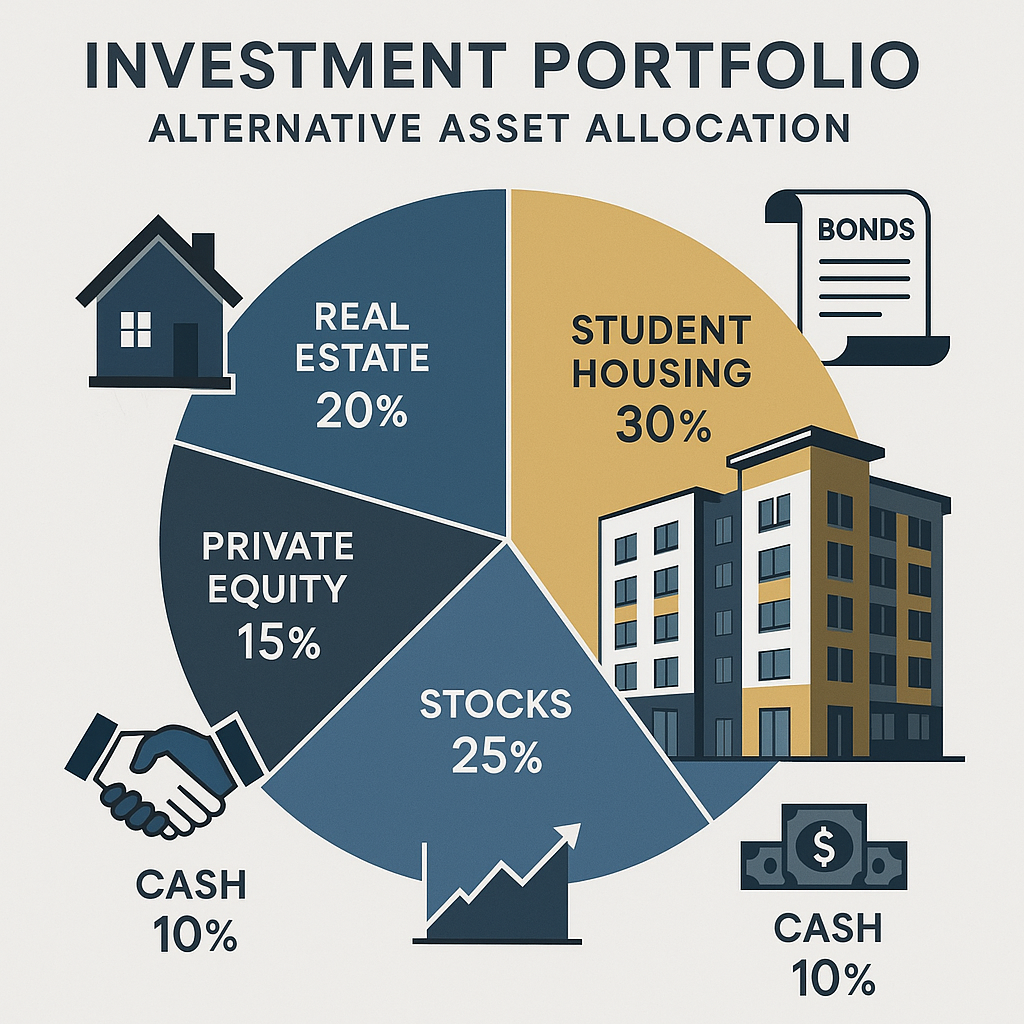
Professional athletes are increasingly diversifying their portfolios beyond traditional equities, and purpose-built student housing is one alternative asset class drawing their attention — combining demographic demand drivers with hands-on asset management. Like any private investment, it carries real risks and is not right for everyone.
Why High-Net-Worth Athletes Are Exploring Alternative Asset Classes
Professional athletes represent a unique subset of high-net-worth individuals characterized by compressed earning windows, significant tax burdens, and a pressing need for financial strategies that extend well beyond their playing careers. Many athlete investors and their financial advisors have looked beyond the traditional 60/40 portfolio toward alternative asset classes in search of additional diversification and exposure to tangible, cash flow-generating assets. Whether alternatives are appropriate, and in what proportion, depends on each investor's circumstances, liquidity needs, and risk tolerance.
Alternative investments — including private equity, private credit, real estate, and infrastructure — provide exposure to assets with tangible underlying value that are not priced daily in public markets. For athletes accustomed to performance-driven environments, the hands-on asset management approach characteristic of private market investing can be a natural extension of their competitive mindset. It is worth remembering, however, that the absence of daily pricing does not mean the absence of risk: private asset values fluctuate, and illiquidity means capital is committed for years.
The demographic profile of today's professional athlete investor has evolved considerably. Armed with financial education, access to institutional-quality investment opportunities, and awareness of the wealth preservation failures experienced by previous generations of athletes, contemporary sports professionals increasingly demand transparency, alignment of interests, and direct participation in investment strategy. That evolution favors managers who compete on operational value creation and full disclosure rather than financial engineering.
The Investment Thesis Behind Purpose-Built Student Housing
Purpose-built student housing is a subset of the alternative real estate market characterized by enrollment-driven demand and academic-calendar lease structures. Demand at the large flagship universities that developers typically target has historically been resilient, even as aggregate U.S. higher-education enrollment has fluctuated over the past decade — which is precisely why market selection matters so much in this sector.
The supply side presents its own dynamics. Legacy on-campus dormitory infrastructure at many universities suffers from decades of deferred maintenance and obsolete unit configurations. Zoning restrictions, community opposition to large-scale student developments, and the capital-intensive nature of ground-up construction create meaningful barriers to entry in many markets. Where demand from matriculating students meets constrained new supply, well-located purpose-built assets can benefit — though supply conditions vary significantly by market and can change.
Well-located, professionally managed student housing has historically exhibited strong occupancy, with lease commitments often secured months before the academic year begins, and annual lease cycles that create regular repricing opportunities. These are historical patterns, not guarantees: occupancy, rent levels, and property performance depend on the specific market, asset, and operator, and development-stage investments carry construction and lease-up risk on top of market risk.
The thesis also extends beyond financial metrics. Providing high-quality, safe housing for students pursuing higher education represents a tangible contribution to community development and educational access. For athlete investors who maintain strong connections to their alma maters, student housing can offer alignment between financial objectives and personal values.
Diversification Considerations
Private real estate can play a diversifying role in a portfolio concentrated in public equities, because its value drivers — local supply and demand, property-level operations, enrollment patterns — differ from those of public markets. Investors should treat reported correlation statistics for private real estate with care, however: because private assets are appraised periodically rather than priced daily, measured correlations and volatility tend to understate economic exposure. Diversification is a reason to consider the asset class, not a promise of protection.
Return potential in student housing varies widely with asset quality, location, leverage, market conditions, and execution, and there is no assurance that any investment objective will be achieved. Development-stage strategies in particular can produce a wide range of outcomes, including loss of capital. Investors evaluating any offering should review the sponsor's complete track record — including deals that underperformed — and the specific assumptions behind any projections in the offering documents.
The sector's performance through past downturns is often cited by its proponents, and student housing did hold up comparatively well through some prior stress periods. But past resilience is not a guarantee of future results, and individual properties and funds performed very differently from sector averages in every downturn, including 2008–2009 and the pandemic.
Real estate investments can also offer tax attributes — depreciation deductions, cost segregation, and potential like-kind exchange treatment under Section 1031 — that may matter to athletes in high marginal tax brackets. Tax outcomes depend entirely on individual circumstances and current law; investors should evaluate any investment's tax profile with their own tax advisors.
Hands-On Asset Management: From Field to Real Estate Operations
The transition from professional athletics to real estate investing reveals parallels in skill sets and success factors. Elite athletes bring disciplined preparation, performance accountability, resilience, and the capacity to execute complex plans under pressure — attributes that translate to the operational demands of hands-on asset management.
Hands-on asset management in student housing requires knowledge of property operations, student preferences, university enrollment trends, and competitive positioning in local markets. Value-add strategies demand active work across operations: unit renovations, amenity enhancements, and marketing initiatives that support occupancy and pricing. Quarterly asset reviews, monthly operating statement analysis, and capital expenditure oversight provide tangible engagement opportunities for investors who want to measure progress through concrete metrics.
Successful implementation requires partnership with experienced operators who have sector expertise, established operational infrastructure, and a documented record — the complete record, not a highlight reel. A governance structure that balances meaningful investor participation with professional day-to-day management lets athletes apply their capital and competitive mindset while relying on specialists for execution.
Structuring Considerations for Long-Term Investors
Investment structure meaningfully affects risk allocation, tax treatment, liquidity, and alignment. Common structures use limited liability companies or limited partnerships providing liability protection and pass-through tax treatment. Capital structure matters as well: moderate leverage can enhance returns but also amplifies losses, and investors should understand a fund's leverage policy, debt terms, and refinancing exposure before committing.
Alignment of interests deserves close attention. Fee structures across private real estate managers vary and typically combine management fees with performance-based compensation; investors should understand the complete fee structure — management fees, performance allocations, preferred return provisions, and expense treatment — as set out in a fund's offering documents, along with the sponsor's own capital commitment to each deal. Meaningful sponsor co-investment and clearly disclosed economics are reasonable things to require of any manager.
Exit and liquidity provisions require attention at the outset of any illiquid investment. Student housing strategies commonly target multi-year holds, and there is no public market for fund interests — capital should be viewed as committed for the duration. Reserve accounts, insurance programs, and periodic third-party property assessments are structural protections worth confirming in diligence. None of these features eliminates risk; they are the baseline hygiene of an institutional-quality structure.
This article is for informational and educational purposes only and does not constitute an offer to sell or a solicitation of an offer to buy any security, nor investment, legal, or tax advice. Private real estate investments are long-term, illiquid commitments; there is no public market for fund interests, distributions are not expected during any development period, and investors may lose some or all of their invested capital. Past performance is not a guarantee of future results. Any offering is made only to qualified investors by means of a confidential private placement memorandum and related offering documents.