

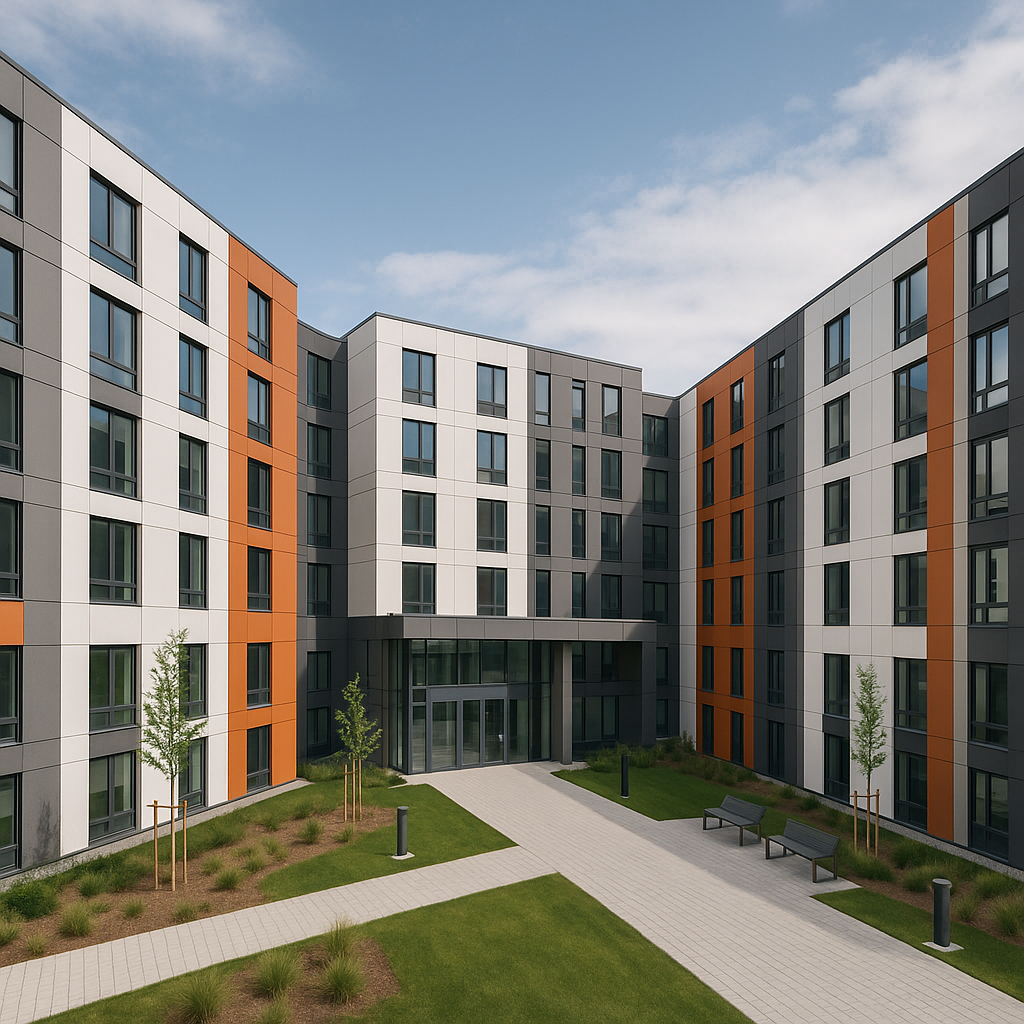
Purpose-built student accommodation has drawn growing attention from family offices as an alternative real estate allocation — combining enrollment-driven demand with hands-on operational value creation. This article looks at the demand drivers, the operational model, the considerations specific to multi-generational capital, and the risks that belong in any honest evaluation.
The Demand Drivers Behind Student Housing
The demand case for purpose-built student accommodation (PBSA) rests on enrollment at the specific universities a strategy targets — and enrollment patterns diverge sharply by institution. At large flagship universities, enrollment has historically been resilient, even as aggregate U.S. postsecondary enrollment declined from its early-2010s peak. That divergence is the sector's central fact: the thesis depends on institution selection, not on a rising demographic tide, and any sponsor's market-selection discipline should be a primary diligence focus.
On the supply side, budget constraints have limited many universities' ability to expand on-campus housing, and dated dormitory inventory often fails to meet contemporary student expectations. At institutions where enrollment strength meets constrained housing supply, well-located off-campus assets have historically sustained strong occupancy. Supply conditions vary by market, however, and new deliveries can change local dynamics — pipeline analysis belongs in every underwriting.
Rising international enrollment at selective institutions and student preference for modern amenities over dated facilities further support demand at the right properties. These are favorable patterns, not certainties, and they concentrate at specific universities rather than applying to the sector uniformly.
Returns, Risk, and Portfolio Considerations
Student housing's appeal to allocators has rested on comparatively stable revenue at well-operated properties — per-bed leasing, academic-year terms, and, commonly, parental guarantees. Return outcomes across the sector vary widely with market, asset quality, leverage, and execution, and no level of return is assured; family offices evaluating a specific offering should anchor on the sponsor's complete, verified record — including underperforming deals — and the assumptions in the offering documents, rather than on sector-level generalizations.
Annual lease resets provide pricing flexibility that can help in inflationary periods, though operating and construction costs rise in those periods too, and the net effect depends on the market. Per-bed revenue models and shared amenity infrastructure can support attractive operating economics at scale; realized margins depend on the property and its management.
On diversification: private student housing's value drivers — local enrollment, property operations, market-specific supply — differ from those of public markets, which is a legitimate reason to consider it within a real assets allocation. Reported correlation and volatility statistics for private real estate should be read cautiously, because appraisal-based valuation smooths reported results and tends to understate economic exposure. Diversification is a portfolio rationale, not downside protection.
Performance Through Cycles — Read Carefully
Proponents often point to the sector's performance through past downturns, and enrollment at many institutions has historically held up, or risen, in weak labor markets as people pursued credentials. Purpose-built student housing broadly weathered some prior stress periods comparatively well. But sector averages concealed wide dispersion: individual markets and properties performed very differently in every downturn, and past resilience does not assure future results. The pandemic demonstrated that even enrollment-anchored demand can be disrupted by events no underwriting anticipated.
Parental financial support for student housing has historically proven comparatively durable, and housing near a physical campus is a need, not a luxury, for enrolled students. These structural supports are real. They coexist with real risks: development and lease-up risk for new construction, leverage risk, university-specific enrollment risk, and the illiquidity of private structures.
Operational Value Creation Through Hands-On Management
Student housing's operational complexity is a genuine source of differentiation for skilled operators. The model demands capabilities conventional multifamily management doesn't: academic-calendar marketing and turnover logistics, per-bed leasing and roommate matching, resident life programming, and revenue management across a compressed annual leasing cycle. Operators who execute these disciplines well can outperform commodity management meaningfully — and operators who don't can impair otherwise sound assets.
Annual lease cycles enable continuous rent optimization and unit-mix adjustment. Ancillary revenue from parking, storage, and services can supplement rental income where properly managed. Technology investment — leasing platforms, smart building systems, resident applications — can reduce operating costs while supporting resident satisfaction. For family offices, the practical question is operator selection: verified occupancy and rent history, capital expenditure discipline, and a platform built for this asset class specifically.
Considerations for Multi-Generational Capital
For family offices, student housing's fit often comes down to duration. Land near major campuses is finite, and well-located assets at enrollment-resilient universities can hold value across long horizons — characteristics that suit patient, multi-generational capital better than return-date-driven vehicles. Construction cost escalation has constrained new supply in many markets, which supports existing assets where it persists, though such conditions can change.
Asset-level scale — commonly tens of millions of dollars per property — offers meaningful portfolio weight without single-position concentration for larger family offices, and the sector's fragmentation outside tier-one markets continues to present acquisition opportunities for well-capitalized, disciplined buyers. Structure matters as much as strategy: family offices should evaluate a sponsor's own capital commitment, its complete fee structure as disclosed in the offering documents, governance and reporting rights, and the liquidity profile of the vehicle against the family's actual distribution needs. Private structures involve multi-year commitments with no public market for interests; capital should be treated as committed for the duration.
This article is for informational and educational purposes only and does not constitute an offer to sell or a solicitation of an offer to buy any security, nor investment, legal, or tax advice. Private real estate investments are long-term, illiquid commitments; there is no public market for fund interests, distributions are not expected during any development period, and investors may lose some or all of their invested capital. Past performance is not a guarantee of future results. Any offering is made only to qualified investors by means of a confidential private placement memorandum and related offering documents.